
Multistage Ammonia Absorption Chiller
Many industrial processes require cooling at different temperature levels. This need can be met either by installing multiple independent refrigeration machines or by using a centralized, multistage ammonia absorption chiller. Ammonia-based absorption chillers are capable of achieving temperatures as low as −60 °C. When designed as multistage systems, they can simultaneously provide cooling capacities at different temperature levels within a single installation.
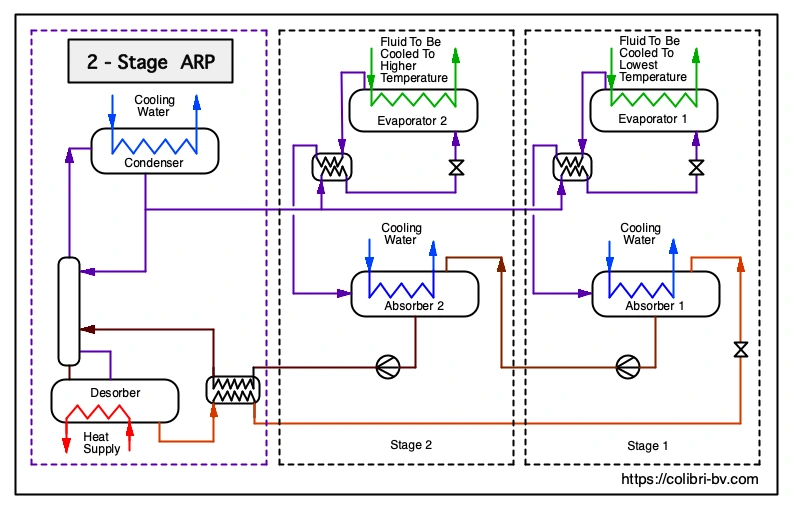
Consider a production plant requires cooling at two different temperature levels. For this application, a two-stage ammonia absorption chiller can be designed as shown in the schematic drawing below.
For each temperature level one set of evaporator, condensate cooler, absorber and solution pump form one stage. Several stages are connected in series one after the other. The solution coming from the desorber first enters the absorber connected to the evaporator with the lowest refrigeration temperature and is pumped from there to the next stage. In each stage the concentration of the solution is increased by absorbing more ammonia.
The required temperature for heat supply is always determined by the evaporation stage with the lowest temperature.
This information is also available in our flyer in the download section
Energy Savings of a Two-Stage Chiller Compared to Two Single-Stage Chillers
If a production process requires cooling at different temperature levels, there are two possible approaches: Providing several independent refrigeration systems or using one single multistage system. Depending on the ratio of the required cooling capacities and the respective temperature levels, a multistage absorption chiller requires less thermal input energy than separate single-stage systems. This is illustrated in the following calculation examples. They are based on cooling water temperatures inlet= 25 °C and outlet= 30 °C.
Cooling Demand at Two Different Temperature Levels :
Example 1: Cooling demand of 620 kW at -30 °C and 1000 kW at -10 °C
Using two separate absorption chillers results in a total heat input of 2790 kW.
For a two-stage chiller meeting the same cooling demand, a heat input of 2600 kW is required. This is a reduction of 190 kW (= 6,8%) compared to two separate systems.
Example 2: Cooling demand of 300 kW at -55 °C and 1000 kW at -35 °C
Using two separate absorption chillers results in a total heat input of 3265 kW.
For a two-stage chiller meeting the same cooling demand, a heat input of 2870 kW is required. This is a reduction of 395 kW (= 12,1%) compared to two separate systems.
Example 3: Cooling demand of 620 kW at -55 °C and 1000 kW at -45 °C
Using two separate absorption chillers results in a total heat input of 5054 kW.
For a two-stage chiller meeting the same cooling demand, a heat input of 4268 kW is required. This is a reduction of 786 kW (= 15,5%) compared to two separate systems.
Cooling a Fluid Over a Large Temperature Difference With a Multistage Ammonia Absorption Chiller
Some fluids need to be cooled over a large temperature difference. In such cases, it can be advantageous to perform cooling not only on the lowest required temperature but also on intermediate temperatures to increase the COP of the chiller. For such cases, a two- or multistage absorption chiller can be designed. The number and the temperature of the cooling stages are a matter of optimization.
Example 4: Cooling a CO2 Stream from +20 °C to -40 °C
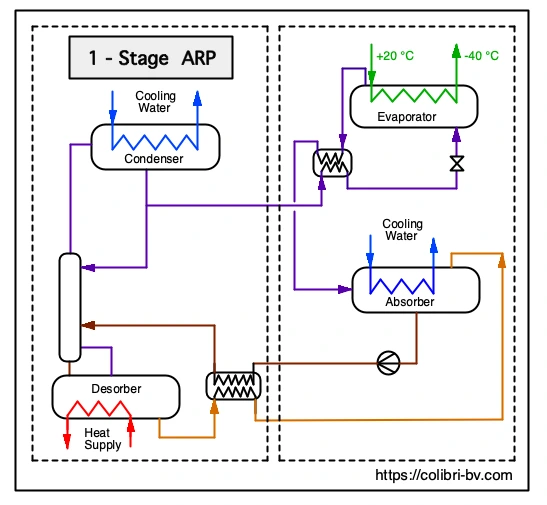
To cool a CO2 gas stream of 30 kg/s at 7 bar from +20 °C to -40 °C a cooling capacity of approximately 1620 kW is required. For a single-stage absorption chiller with an evaporation temperature of -45 °C (look at the schematic drawing below), the required heat input is 4260 kW.
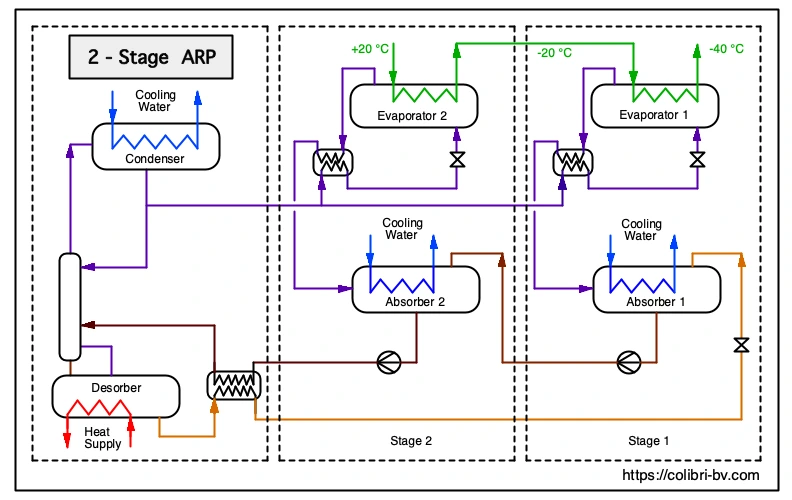
For a two-stage absorption chiller with 1070 kW at -25 °C and 550 kW at -45 °C (look at the schematic drawing below), the required heat input is 3140 kW. This represents a reduction of 1120 kW (= 26,2%) compared to the heat input of a single-stage plant.
Number of Stages of a Multistage Ammonia Absorption Chiller
The number of stages is not limited to two, but can be expanded to three or more depending on the operating conditions. The decision regarding the optimal number of stages for a given system configuration is on the assessment of whether the investment costs for an additional stage justify the savings in heat input.
Capacity Control of the Individual Stages
A multistage system is designed so that each stage delivers its intended cooling capacity. If one of the stages requires less capacity, this has no effect on the others. With suitable control functions, the outputs of all stages can be individually controlled from almost 0% up to the design value.
Cost Differences Between Single- and Two-Stage Chillers
When comparing costs, it’s crucial to consider what is being compared. When comparing the costs of two single-stage chillers with one two-stage chiller, as done in example 1, 2 and 3, the two-stage chiller requires lower investment costs because the desorber, rectification column, condenser and solution heat exchanger are only needed once (albeit larger) instead of twice in two separate chillers.
However, when comparing a two-stage chiller with one single-stage chiller as in example 4, the two stage chiller requires more equipment (evaporator, absorber, pumps, condensate cooler), but all components are smaller.
The cost advantage of each system must be calculated individually for each project by weighing the energy savings against the additional investment costs.
Different Stages for the Heat Input
For absorption chillers using LiBr-water as refrigerant, there are various configurations that optimally utilize the available heat source (temperature and type). Theoretically, these process configurations, as half-, single-, double-effect, or double-lift, can also be applied to absorption chillers using ammonia as refrigerant. In practice, however, in most cases the additional effort for heat exchangers and piping does not justify the efficiency gain or the use of low-temperature heat input.